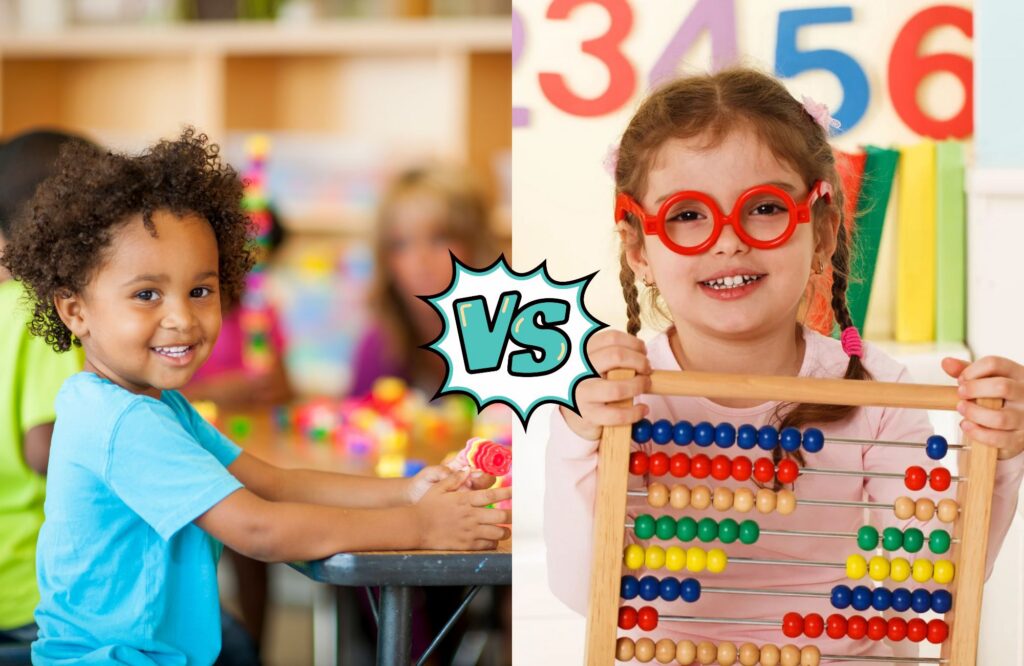
Learning through play is not the opposite of academic learning. In strong early childhood education programs, children learn through a combination of play, conversation, exploration, teacher guidance, and direct instruction. Play-based learning can support language development, cognitive development, physical development, social skills, and early academic concepts. Direct teaching can also help children master specific skills efficiently.
In this article, we’ll compare both approaches fairly, explain what research supports and where findings remain contested. We’ll also explain how play-based learning works during an actual preschool day. We wrote this for Brooklyn parents whose real concern is school readiness and whether their child will enter kindergarten prepared to learn.
What Is the Difference Between Play-Based and Academic Preschool?
The main difference is how learning experiences are organized, not whether learning happens.
An academic preschool model usually relies more heavily on direct, teacher-led instruction. Teachers may introduce phonics, numbers, handwriting, or other skills in a planned sequence. Children may spend more time practicing clearly defined tasks chosen by the teacher. That approach is not automatically rigid or inappropriate. Direct instruction can be useful when teachers need to explain a specific concept, model a skill, or provide additional support.
Play-based learning uses children’s exploration and play activities as a major part of the learning environment. Children may build, create, engage in pretend play, move, experiment, interact, and pursue their own interests. Teachers still have an important role. Adult involvement can include choosing materials, asking questions, adding vocabulary, observing children’s interests, and guiding an activity toward an early learning goal.
The National Association for the Education of Young Children’s guidance on developmentally appropriate practice describes a play-based approach to engaged learning. It also recognizes guided play, where children remain active participants while teachers intentionally support learning.
| Approach | Teacher’s Role | Child’s Role | Common Strength | Possible Limitation |
| Direct instruction | Leads and demonstrates specific skills | Follows a planned learning sequence | Efficient practice of discrete skills | Can become too passive if it dominates classroom practices |
| Free play | Prepares the environment and observes | Chooses the activity and direction | Independence, imagination, exploration | Specific learning goals may not emerge on their own |
| Guided play | Plans, observes, asks questions, and scaffolds | Directs much of the activity while responding to guidance | Combines active learning with intentional teaching | Effectiveness depends on teacher skill and implementation |
A strong preschool does not necessarily choose one extreme.
The Academic Model: Where Direct Instruction Can Help
Direct instruction can be effective when children need focused help learning a specific skill. A teacher does not have to wait for every idea to appear naturally through self-directed play. Directly introducing a letter sound, counting strategy, vocabulary word, or classroom routine can support children’s own learning. This matters especially when teachers are trying to support early literacy or identify a child who needs additional practice.
The important question is not whether direct instruction should ever happen. It is how much of the preschool day it occupies and whether children still have opportunities for active learning, exploration, social interaction, and problem-solving.
The Play-Based Framework: What Research Supports
Playful learning can support cognitive skills while keeping young children actively involved in the learning process. One important source is the 2022 systematic review and meta-analysis by Kayleigh Skene et al. The review examined 39 guided-play studies. Seventeen studies involving 3,893 children between ages 1 and 8 were included in the meta-analysis.
Compared with direct instruction, guided play produced stronger results for some outcomes, including:
- Early math skills
- Shape knowledge
- Task switching, an executive-function skill
Compared with free play, guided play also showed an advantage for spatial vocabulary. The researchers did not find guided play superior to direct instruction for every outcome. Literacy and the social-emotional outcomes included in the analysis did not show significant differences between the two approaches.
This is why we avoid saying that play is always better than teaching. Instead, the evidence suggests that play supports learning particularly well when children are active, engaged, and given meaningful choices while adults intentionally extend their thinking.
What Does the HighScope Curriculum Comparison Study Tell Us?
A small long-term experiment raised important questions about preschool environments dominated by highly scripted teaching.
The High/Scope Preschool Curriculum Comparison Study Through Age 23 randomly assigned 68 children to three preschool approaches:
- A Direct Instruction model
- The HighScope active-learning model
- A traditional Nursery School model emphasizing child-initiated activity
For about a decade, researchers found virtually no differences between the groups in intellectual and academic performance. By age 23, however, differences had emerged in several social and behavioral outcomes, with the Direct Instruction group showing less favorable results on some measures.
The study was small and used curriculum models from the late 1960s, so it should not be treated as universal proof. Its value is more specific. It suggests that preschool quality should not be judged only by short-term academic performance.
Where Is the Research Genuinely Contested?
The real debate is not whether children should play or receive instruction. It is how to balance play, active learning, and explicit teaching.
The Skene et al. systematic review of guided play found substantial variation in how guided play is defined and implemented. It also found that guided play performed better than direct instruction for some outcomes, including early math, shape knowledge, and task switching, but not across every area studied.
The National Association for the Education of Young Children supports using a mix of self-directed play, guided play, and direct instruction based on children’s development, interests, language, and cultural context.
This means strong early childhood teaching does not have to choose one method. Teachers can use play to support exploration and problem-solving while using direct instruction when children need focused help with specific skills.
What Are the Six Types of Play?
Researcher Mildred Parten identified six forms of social participation in her classic research on how children play. OpenStax’s review of Parten’s research identifies them as unoccupied, solitary, onlooker, parallel, associative, and cooperative play.
These forms should not be treated as a rigid age-based ladder. Young children may use different kinds of play depending on the activity, environment, and children around them.
| Type of Play | What It Looks Like | What Children Can Practice |
| Unoccupied play | Exploring movement, objects, or surroundings without an organized activity | Body awareness, observation, sensory exploration |
| Solitary play | Playing independently | Concentration, independence, experimenting with own ideas |
| Onlooker play | Watching children play without joining them | Language exposure, observation, understanding social patterns |
| Parallel play | Playing beside other children using similar materials | Awareness of peers, imitation, boundaries, early social skills |
| Associative play | Children interact and share materials without one shared goal | Language skills, negotiation, sharing, emotional skills |
| Cooperative play | Children organize roles, rules, or a common goal | Self-regulation, problem-solving, teamwork, planning |
Young children also engage in construction, imaginative, pretend, physical, and rule-based play. The National Association for the Education of Young Children explains how different forms of play support development, including language, physical development, problem-solving, peer relationships, self-regulation, and social skills.
For example, construction play can involve shape, balance, spatial relationships, and problem-solving. Imaginative and role play give children opportunities to practice language, negotiation, and perspective-taking, while physical play supports movement and coordination.
Structured activities such as simple board games can also involve rules, turn-taking, counting, memory, and self-regulation. Many play experiences overlap, so a pretend restaurant might involve construction, cooperative play, literacy, math, imaginative thinking, and social interaction at the same time.
What Does Play-Based Learning Actually Look Like Hour to Hour?
High-quality play-based learning does not mean children simply play without purpose all day. A strong learning environment combines predictable routines, active learning, teacher guidance, direct instruction, and opportunities for children to explore.
At Little Me Daycare Center, our Brooklyn preschool program follows a structured daily schedule that includes free-choice centers, morning meeting, literacy, math, outdoor time, creative activities, and small-group learning.
Here is how play and intentional teaching can work within that kind of day.
8:00-9:00: Arrival and Free-Choice Centers
Children begin the day with free-choice centers. During this time, they can explore materials, make choices, interact with other children, and follow their own interests.
For example, a child building with blocks might experiment with height, balance, shapes, and counting. A teacher can extend the activity by asking questions such as, “How many blocks did you use?” or “What could make the tower stronger?”
The child remains actively involved while the teacher supports language development, cognitive skills, and problem-solving.
9:00-9:30: Morning Meeting and Calendar Time
Morning meeting introduces more structured group learning. Children practice listening, participating in a group, following routines, taking turns, and communicating with teachers and classmates. These are important parts of social-emotional development and kindergarten readiness.
9:30-10:15: Literacy Block
Playful activities can give children additional ways to use those early literacy skills. For example, a pretend grocery store could include food labels, shopping lists, signs, and conversations between shoppers and cashiers.
Activities like these can support print awareness, vocabulary, language skills, social interaction, and imaginative thinking.
10:15-11:00: Math Block
Hands-on materials can help children explore these ideas actively. During block or construction play, for example, a teacher might ask, “Which tower is taller?” or “What shape would fit here?”
The goal is not simply to give children the answer. Questions and materials can encourage them to compare, count, notice patterns, and work through problems themselves.
11:00-11:45: Outdoor Time
Outdoor time gives children opportunities for movement, physical development, and social interaction. Running, climbing, balancing, and playing games can help children practice coordination and gross-motor skills. Playing with others also gives them opportunities to take turns, communicate, follow rules, and develop self-regulation.
2:00-3:00: Art, Music, or Dramatic Play
Art can support fine motor skills and creative thinking. Music creates opportunities for rhythm, listening, movement, and language. Dramatic and pretend play allow children to create stories, take on roles, communicate ideas, and interact socially.
3:00-4:00: Small-Group Activities and Social Skills
Small-group activities give teachers opportunities to work more closely with children. Teachers can reinforce a skill, guide children through a shared activity, or help them practice cooperation, communication, and problem-solving with peers.
4:00-6:00: Free Play, Wind-Down, and Pickup
The day ends with free play, quieter activities, and pickup. This gives children another opportunity to make choices and interact with classroom materials while transitioning out of the structured part of the day.
This is why play-based learning should not be confused with “just playing.” Play can happen alongside direct literacy and math instruction, group routines, teacher-guided activities, outdoor movement, and small-group learning. The National Association for the Education of Young Children notes that play can support self-regulation, language, cognitive and social development, as well as learning across academic areas.
Does Play-Based Preschool Prepare Children for Kindergarten?
Yes, when it intentionally supports the academic, social, emotional, physical, and cognitive skills children need for school.
School readiness is bigger than being able to complete a worksheet. Kindergarten children are expected to participate in a group, communicate with adults and peers, manage classroom transitions, engage with learning materials, and gradually work more independently.
Readiness can include the ability to:
- Listen and communicate
- Follow directions
- Participate in a group
- Take turns
- Handle frustration with growing independence
- Recognize emerging letters, sounds, numbers, shapes, and patterns
- Use fine motor skills for drawing and early writing
- Ask questions
- Use problem-solving skills
- Move between classroom activities
- Interact with other children
- Express ideas and needs
These social and cognitive skills develop alongside early academic knowledge. Children learn about numbers while building. They develop language while negotiating a role in pretend play. They practice self-regulation when waiting for a turn. They develop fine motor control while drawing, cutting, building, or manipulating small objects.
That is why school readiness should not be reduced to how many letters or numbers a preschooler can identify. At Little Me Daycare Center, we combine early literacy and math with classroom routines, independence, social and emotional development, creativity, and play.
What Should Parents Look for When Comparing Preschools?
Instead of asking only whether a preschool is “academic” or “play-based,” look closely at the classroom practices.
Ask:
- What does a typical day look like?
- How much free play and guided play do children have?
- How do teachers support play?
- How do teachers introduce literacy and math?
- What does adult involvement look like while children explore?
- How does the classroom support language development?
- How do teachers encourage children’s interests while still meeting learning goals?
- How do you help children build self-regulation?
- How do you support children who need extra help?
- How do you measure school readiness?
- What opportunities do children have for imaginative play, physical play, and construction play?
- Can families observe the learning environment during a tour?
The answers reveal much more than a label. A preschool can call itself play-based but provide little meaningful teacher interaction. Another may describe itself as academic while still using active, playful, socially interactive experiences throughout the day. Watch what children and teachers are actually doing.
Kindergarten Readiness Is Bigger Than Worksheets
The research does not support treating preschool as a choice between children playing and children learning. Young children learn through play, direct teaching, conversation, repetition, movement, stories, experimentation, mistakes, and interaction with other people. Each approach can support learning when used intentionally. Direct instruction can help teach specific skills efficiently. Playful learning creates opportunities for problem-solving, language, cognitive development, creative thinking, social interaction, self-regulation, and physical development.
For us, strong early childhood education brings those experiences together. If you are comparing preschool options in Brooklyn, explore our preschool program for children ages 3 to 5 to see how we combine structured early learning, play, literacy, math, creativity, and social development. You can also schedule an in-person tour of Little Me Daycare Center. During your visit, you can see the classroom environment in action, meet our teachers, and ask how we prepare children for kindergarten.